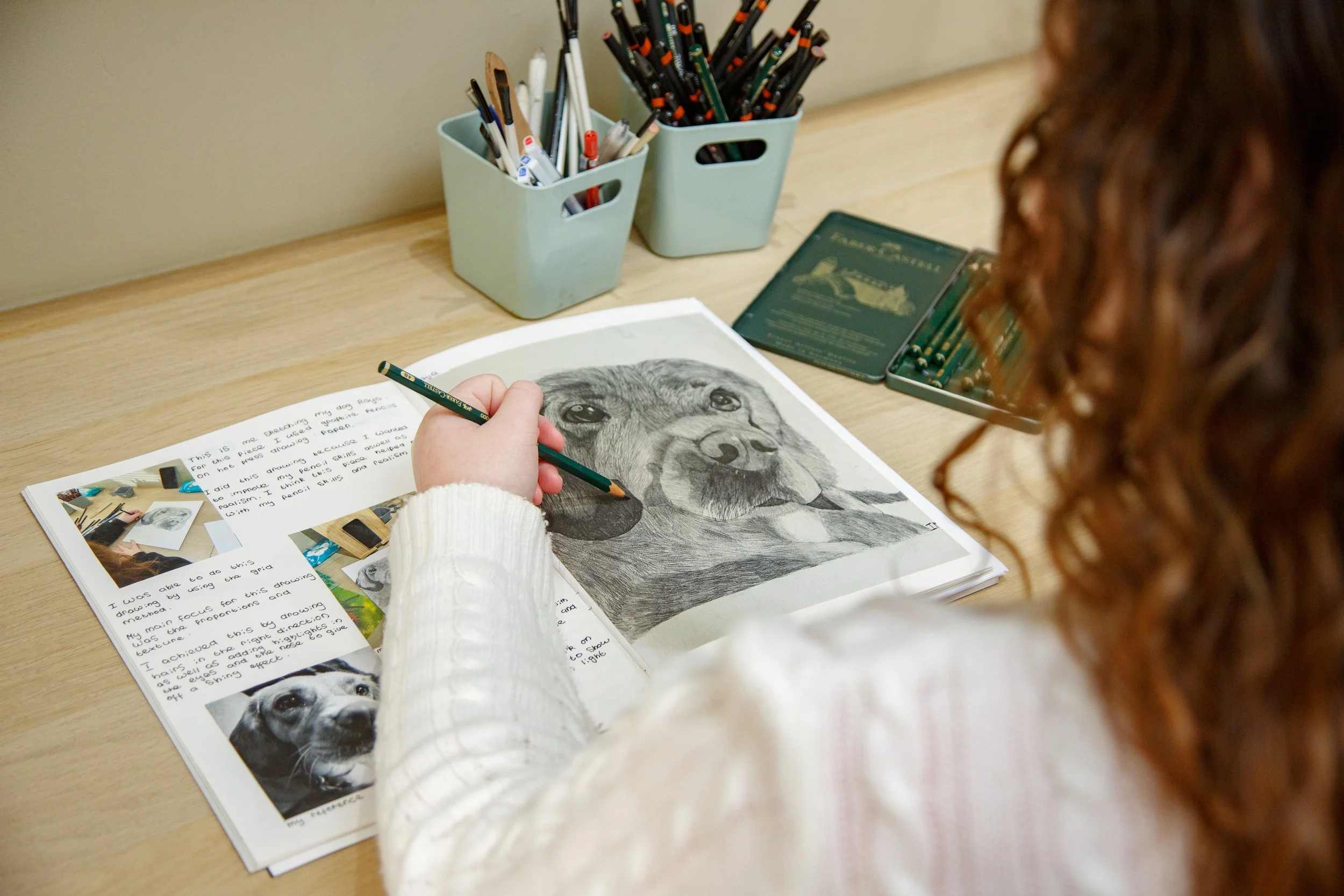
My Go-To Graphite Drawing Tools
I get asked so often about the specific drawing tools, pencils and papers we use in the studio, so I thought it would be lovely to gather all my absolute favourites into one place for you.
Before we dive in, a quick full-disclosure note: this isn't an ad, nor am I sponsored or paid by any of these brands. Everything mentioned here is simply what I genuinely love, trust and use in my own creative practice and studio sessions with my clients.
1: Graphite Pencils
In the studio, both my clients and I use Derwent Graphic Pencils and Faber Castell pencils. They are brilliant for all skill levels because the quality is just wonderful. Their hexagonal shape feels so comfortable in your hand, and they are fantastic for smooth sketching and seamless blending. The graphite is incredibly durable, so they don't break every time you sharpen them! To help you get those deep, impactful tones, they come in a full range of grades from 9H all the way to 9B, and you can pick them up individually or in sets.
2: Mechanical Pencils
If you are in search for a pencil that is light-weight and comfy in the hand, then Pentel mechanical pencils are fabulous. They come in a variety of lead widths, with the fine ones being an absolute dream for delicate, intricate details. They are easy to refill, and you can buy leads in different grades like HB, 2H or 2B to suit your style.
3: Erasers
The Mono Zero eraser is an absolute favourite of all ages in the art studio and is designed for precise erasing capabilities. The smallest size has a 2.3mm round tip, while the rectangular version is 2.5mm. Refilling the eraser is easy, ensuring long-lasting use.
For softer lifting, Winsor & Newton and Faber-Castell both make great kneadable putty erasers. They are wonderful for gently lifting charcoal and graphite marks without harming the paper. I have to admit, their Blu-Tack-like texture means they often get sculpted into funny little studio creatures during children's sessions… I sometimes have to hide them!
When it come to rubbing out larger areas without leaving a mess, the Staedtler Art Eraser is a great. Unlike cheaper rubbers, it won't smudge your work or tear your paper. I absolutely love two black erasers I have in the studio, but I couldn’t tell you their brand name. They are so good to work with. The problem is they are a devil to find in art shops as no one seems to stock them!
4: Graphite Powder
Graphite powder is very popular in the studio, particularly for placing down soft base layers and creating smooth textures. We use Jackson’s Art Supplies own-brand in the colour of black. My tip is to keep a few clean, soft brushes aside (don’t use them for painting) to help you apply the powder onto your paper.
5: Sharpeners
Achieving high standards of drawing, shading and layering requires well-sharpened pencils. The Faber-Castell sharpener is an excellent choice for keeping your pencils in good condition, as the blade easily cuts through the wood. The twin version is super handy if you want to sharpen both standard graphite and thicker coloured pencils to a fine point.
6: Charcoal
Yes, you can absolutely mix charcoal with graphite! If you fancy trying it, the Winsor & Newton Artists' Charcoal Assorted pack is a great starting point. With a dozen 14cm charcoal sticks in varying thicknesses, they are a pleasure to use. You can also purchase charcoal as a powder too. Personally, I am not a fan of the wood-cased charcoal pencils as they sound like nails on a blackboard, so I find these uncomfortable to use, but you may love them.
7: Blending Stick
Please don't smudge and blend with those oily fingers! (Teacher voice on!) Cretacolor Stumps have a pencil-shaped paper stick to help you blend and create that perfect soft finish. They come in various sizes so you can control small or large areas easily. Nevertheless, cotton buds and tissue can also help you smudge your graphite pencil too.
8: Paper
Choosing paper can feel like a bit of a minefield, as it really comes down to your personal drawing style and how you like your graphite to feel under your hand. Here is a quick guide to different paper types and weights to help you find your match:
Surface Textures and Types:
Smooth / Bristol Board: If you love working with high realism, ultra-fine mechanical pencils, crisp lines and seamless blending, smooth Bristol paper is an absolute dream. Because it has almost no surface texture (no "tooth"), your graphite glides across it smoothly, making it perfect for detailed portraits or botanical work.
Fine / Medium Grain Paper: A classic choice for general drawing. It has just enough surface texture to grab hold of the graphite, allowing you to build up rich, dark tones without your pencil sliding around.
Textured Paper: If you enjoy expressive, grainy sketches with lots of character and expression, a paper with a bit more texture will catch the graphite in its grooves, giving your shading a lovely, artistic atmosphere.
Paper Weights:
Lightweight Paper (around 90–130 gsm): Perfect for quick sketches, thumbnail ideas or warm-up studies in your everyday sketchbooks. It’s light and easy to carry around, though it won't hold up to heavy layering or aggressive erasing.
Medium-Weight Paper (around 150–200 gsm): This is a good all-rounder! It is ideal for most finished graphite drawings, giving you enough body to build up rich tonal layers without the paper buckling under pressure.
Heavyweight Paper & Boards (220–300+ gsm): If you love working with heavy graphite shading, or even want to explore combining washes such as liquid graphite, watercolour or ink, you’ll want a thick paper or board that can handle the extra moisture and vigorous burnishing without warping or damage.